
In enterprise applications, it is common to find customer or taxpayer information replicated across multiple systems. Over time, some repositories become outdated while newer services provide more accurate and authoritative data.
A recent challenge involved refactoring a lookup process responsible for retrieving person and company registration data. The business requirement was simple:
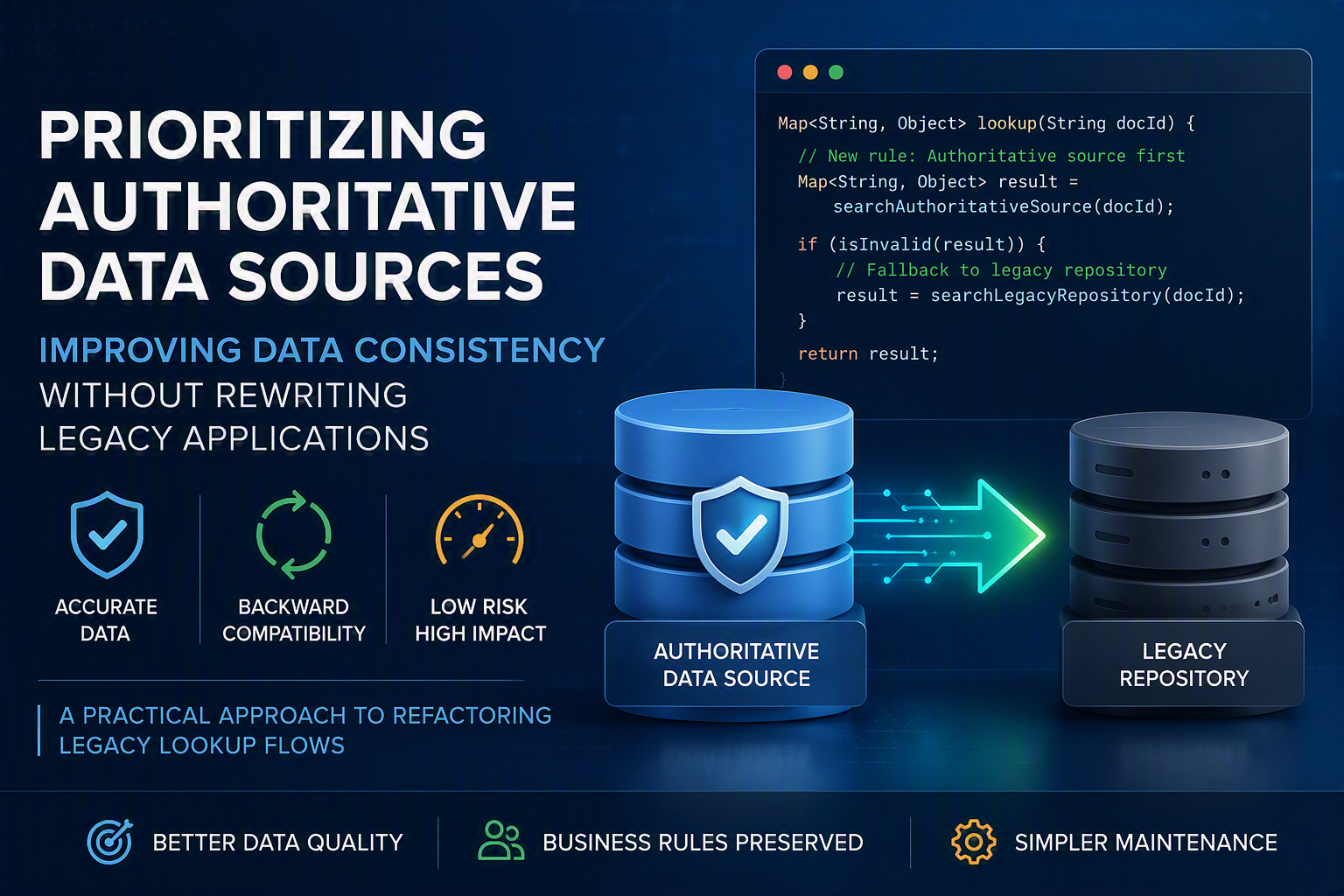
Always retrieve information from the authoritative source first and use the legacy repository only as a fallback mechanism.
Although the requirement sounded straightforward, the existing implementation followed the opposite approach.
The Original Flow
The legacy solution performed lookups in a local repository first and only consulted the authoritative service when the information could not be found.
Legacy Repository
        ↓
Data Found?
        ↓
      YES → Return Result
        ↓
      NO
        ↓
Authoritative Service
        ↓
Return Result
From a business perspective, this introduced an important issue.
Records returned from the local repository could be outdated compared to the authoritative source, resulting in inconsistencies across systems.
The Desired Architecture
The new requirement was to invert the lookup order so that the authoritative source became the primary provider of information.
Authoritative Service
        ↓
Data Found?
        ↓
      YES → Return Result
        ↓
      NO
        ↓
Legacy Repository
        ↓
Return Result
This approach guarantees that users receive the most current available information while preserving backward compatibility with historical records stored in legacy systems.
Identifying the Real Integration Path
At first glance, the solution seemed to require significant changes across:
- User Interface components
- Business logic layers
- Service integrations
- Middleware configurations
However, during the analysis phase, it became clear that the application was already consuming the authoritative source through existing service operations.
The integration infrastructure was already available and operational.
The only issue was the lookup sequence.
This finding reduced the implementation effort substantially and avoided unnecessary modifications to stable components.
Refactoring the Lookup Method
The original implementation resembled the following logic:
Map<String, Object> result =
    searchLegacyRepository(documentId);

if (isInvalid(result)) {

    result = searchAuthoritativeSource(documentId);
}

return result;
The refactored version simply inverted the execution order:
Map<String, Object> result =
    searchAuthoritativeSource(documentId);

if (isInvalid(result)) {

    result = searchLegacyRepository(documentId);
}

return result;
While the actual implementation involved additional validations and data normalization, the architectural change was intentionally minimal.
This strategy reduced regression risks and simplified testing.
Validating Returned Data
One challenge was deciding when a lookup should be considered successful.
Instead of checking only whether a response object existed, the implementation validated whether meaningful business information was present.
For example:
boolean validData =
    name != null &&
    !name.trim().isEmpty();
This prevented empty responses from being treated as successful lookups and ensured that the fallback mechanism was triggered when necessary.
Preserving Backward Compatibility
One of the main goals was to keep all existing business rules intact.
The following components remained unchanged:
- Input validation
- Duplicate record validation
- User interface behavior
- Existing service contracts
- Data bindings
- Legacy repository integration
Only the lookup orchestration logic was modified.
This significantly reduced implementation complexity and deployment risk.
User Experience Considerations
Another requirement was informing users about the origin of the displayed information.
Instead of introducing complex conditional rendering logic, a simple informational panel was added to the screen:
The displayed registration data originates from the organization’s authoritative data source. Any inconsistencies should be corrected through the official registration channels.
This approach improved transparency while keeping the implementation lightweight
Lessons Learned
This project reinforced several important software engineering principles:
1. Understand the Existing Architecture Before Refactoring
It is easy to assume that a new requirement demands new integrations.
A detailed investigation revealed that the required service was already in place.
2. Favor Small, Targeted Changes
When the problem is the execution sequence, avoid redesigning the entire solution.
A focused refactoring often delivers better results with lower risk.
3. Preserve Stable Components
User interfaces, bindings, and middleware configurations had already been tested in production scenarios.
Keeping them unchanged reduced uncertainty.
4. Implement Explicit Fallback Strategies
Multiple data sources should have clear priorities.
An explicit hierarchy prevents inconsistencies and improves predictability.
Final Thoughts
Many enterprise systems evolve through years of integrations, migrations, and business changes. As a result, lookup flows frequently become more complex than necessary.
Sometimes the most effective solution is not introducing new technology but simply reevaluating which source of truth should be consulted first.
In this case, a small change in the orchestration layer delivered better data quality, preserved compatibility with legacy systems, and met business requirements without requiring large-scale architectural changes.
For enterprise applications, that combination is often the ideal outcome.
Leave a Comment